On June 1, 2026, at COMPUTEX in Taipei, NVIDIA CEO Jensen Huang announced the Vera Rubin platform had entered full production. Who is building it? A supply chain spanning 30 countries, 350+ factories, and 150 Taiwanese partners. What happened? This AI compute hardware built for "agentic AI" delivers 3.6 EFLOPS of inference per rack and cuts token cost to roughly a tenth of the previous generation. Why should a precision shop care? Because AI factories are moving from air to full liquid cooling, robots are walking into factories, and every cold plate, quick connector, and robot joint is custom-machined work.
Vera Rubin isn't a single chip. It's a full rack-scale system. Huang put it bluntly in his GTC Taipei keynote: agentic AI is a new kind of workload, where one prompt can trigger thousands of steps of reasoning, retrieval, and tool use. The hardware powering it looks nothing like a training card from two years ago.
The numbers are wild. A single NVL72 rack pushes 3.6 EFLOPS (FP4) — 3.3x over GB300. Rack assembly dropped from two hours to five minutes. The Taiwan supply chain is twice the size of the Grace Blackwell era; NVIDIA assembles over a million MGX rack components across 25 Taiwanese sites with 500+ local partners. By Huang's account, 2026 is the year AI factories go vertical, with hyperscalers spending around $725 billion this year alone.
Here's the part that matters for metal shops: NVIDIA also put "physical AI" on the table at the same show. Cosmos 3 (an open world model), the Isaac GR00T humanoid platform, and the Alpamayo self-driving model. Toyota, FANUC, Yaskawa, KUKA, and ABB — the old guard of manufacturing — are now running NVIDIA's Omniverse and Isaac for digital twins and simulation.
For two years the industry chased training cards. This year the wind shifted. In the words of a Sequoia report, "Agent companies" billing by token consumption are showing up. Inference, not training, is now the main battlefield for compute — which means data centers need more, denser, hotter rooms.
How hot? Single-chip power draw jumped from 700W past 1000W. Air cooling simply can't keep up, so liquid cooling went from "nice to have" to "mandatory." Industry estimates put the 2026 global AI-server liquid cooling market at roughly ¥107.6 billion, up 271% year over year. China's liquid-cooling penetration in data centers climbed from under 3% in 2021 to 20% in 2025, then to 37% in 2026, with projections hitting 82% by 2030.
Inside a liquid system, four parts — cold plates, CDUs, quick connectors, and manifolds — account for about 90% of the value. The cold plate sits right against the chip: flow channels as narrow as 3mm, wall thickness within ±0.1mm, base flatness ≤0.03mm per 100mm. Miss those by a hair and heat transfer drops. Quick connectors must be zero-leak and survive 5,000+ mating cycles. These are stainless and aluminum parts a three-axis mill can't touch; they need five-axis CNC and precision welding. This kind of liquid-cold-plate precision machining is the hardest and most valuable slice of AI server structural components.
Pocket one is liquid-cooling structural parts. A GB200 NVL72 rack carries about $80K of liquid cooling; GB300 pushes that to $96K. From plates to manifolds to connectors, it's all precision metal. For a shop doing sheet metal or stamping, this is the window to move from "generic brackets" to "high-precision thermal components" — at margins well above commodity work.
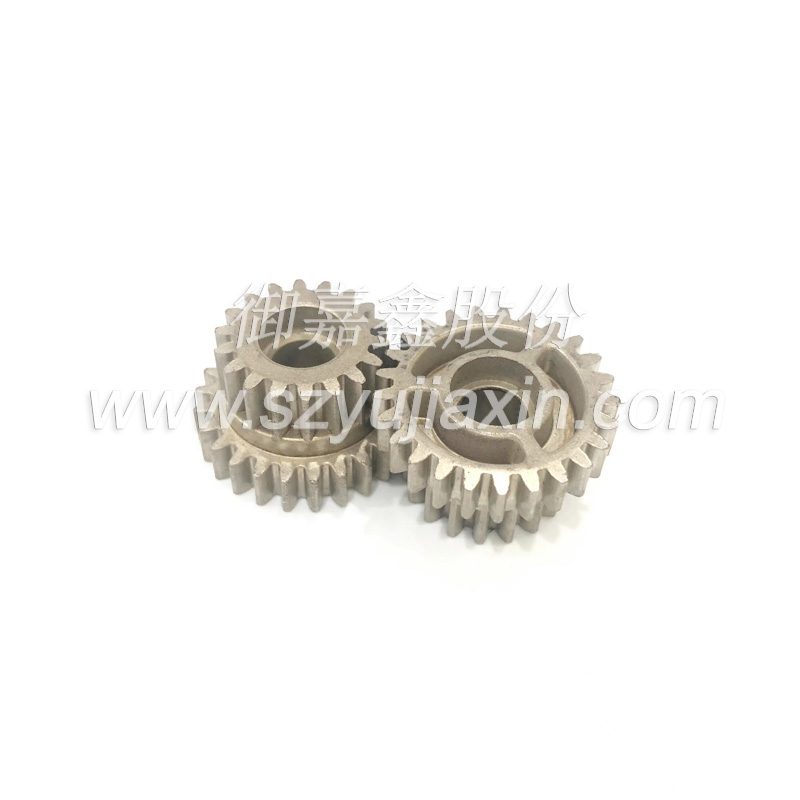
Pocket two is robot joints and dexterous hands. Joint modules are roughly 70% of a humanoid's bill of materials. Unitree's H2 carries 31 body degrees of freedom; add a five-finger hand and you're at 75, with a 15kg peak arm load. Every reducer housing, drive shaft, and sensor bracket is small-batch, high-precision, high-mix custom work. It rhymes with how phone metal mid-frames scaled a decade ago. Yujiaxin's humanoid robot gears and precision structural components are exactly this direction made real.
Pocket three is one-stop, multi-process delivery. Customers no longer want a single part — they want MIM+CNC, PM+CNC, or casting+CNC combinations. A shop like Yujiaxin Tech, with a mature precision-machining process base, can own the whole chain from DFM review through tooling, prototyping, and mass production. Tellingly, procurement's bar for certifications keeps rising; IATF 16949 and PPAP are now table stakes.
Yujiaxin Tech (御嘉鑫股份) was founded in Shenzhen in 1998. For nearly three decades the company has done one thing: high-precision custom machining to customer drawings and samples. Backed by a mature precision-machining process base and imported German, Japanese, and Swiss equipment, its parts land in medical devices, smart robots, automotive, and 3C electronics, and ship to Europe, East Asia, and Southeast Asia.
The AI compute hardware wave, at its core, is a contest of precision manufacturing muscle. If you have drawings for cold plates, manifolds, robot joints, or structural parts, send them over — we'll run a free DFM review and quote within 48 hours.
 info@szyujiaxin.com
  中文
中文 English
 日本語
日本語 Deutsch
 Русский
 SHENZHEN YUJIAXIN TECH CO.,LTD.