Researchers from the University of Grenoble Alpes and HP have proposed a step-by-step method to predict shape changes during the sintering of 316L stainless steel parts (Courtesy Additive Manufacturing/Elsevier)
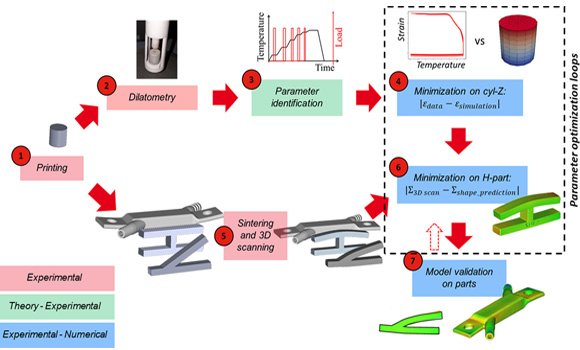
Researchers from the University of Grenoble Alpes and HP Inc have proposed a step-by-step method to predict shape changes during the sintering of 316L stainless steel parts made using metal Binder Jetting. The method, detailed in the paper'A calibration method to predict shape change during sintering: Application to 316L parts made by Metal Binder Jetting', combines experimental and numerical techniques.
Metal Binder Jetting requires sintering, which leads to shrinkage due to the initially low green density of the part. Shape distortion can also form due to gravity. The prediction of those deformations is, therefore, paramount to reach near-net shape parts.
In the reported method, the anisotropic linear shrinkage is determined by dilatometry, while the viscous deformations are numerically fitted through a calibration part. The model is implemented in HP's proprietary 3D Digital Sintering software and tested across various sintering cycles. It was optimised through iterative loops, reducing deviations between predictions and experiments to below 1%.
Then, angular sectors exhibiting various degrees of overhang are sintered to assess the performance of the model. Results showed that most predictions exhibit maximum deviations below 5%, with filleted parts exhibiting better predictions.
The study highlights the importance of accurate parameter calibration, noting the influence of sintering temperature, density, and microstructural changes. While this work relied on optimisation routines, future improvements could come from machine learning and multi-scale modelling.
By combining experimental data with simulation, the method offers a path to more reliable metal Binder Jetting. The breakthrough could expand the technology's use in industries such as aerospace and medical devices, where dimensional accuracy is critical.
The full paper is available here.
www.univ-grenoble-alpes.fr
www.hp.com
 info@szyujiaxin.com
  中文
中文 English
 日本語
日本語 Deutsch
 Русский
 SHENZHEN YUJIAXIN TECH CO.,LTD.